Does a Rebuilt Title Affect Insurance? Coverage, Costs, and Limitations Explained
|
|
Key takeaways
- Full coverage insurance on a rebuilt title is hard to get, and may only be offered with strict conditions.
- Insuring a rebuilt car can be up to 22% cheaper than insuring a clean title, according to research by Wheelsaway.
- Cheaper liability insurance means more legal and financial risk, less protection, and higher costs in the future.
Can you get full coverage on a rebuilt title?
You can get insurance coverage on rebuilt titles, but it’s often liability insurance only. Some insurers are reluctant to offer full-coverage insurance with a rebuilt title (collision and comprehensive), but as Clifford Schimek, Insurance Expert at Florida Auto Plus Insurance explains, there’s not a lot of consistency in how rebuilt vehicles are handled by insurers.

“Some [insurance companies] won’t write them, some only offer liability, and some allow full coverage with conditions. One company’s ‘no’ is another company’s ‘yes’ – with documentation.
I’ve had one company decline a rebuilt vehicle outright, while another approved full coverage after reviewing the repairs”.
Liability insurance vs. full coverage insurance
Liability is enough to get your car on the road, but ‘full coverage’ (which often refers to collision and/or comprehensive coverage) gives you and your vehicle more security.
Liability
If you’re at fault in an accident, liability insurance will cover damage to another person and/or their property up to your coverage insurance limits. It will also cover the cost of your legal defense if you’re taken to court for an accident you were responsible for.
Full coverage
Full coverage insurance includes everything covered by liability, (collision/comprehensive), and also covers your vehicle in the event of severe weather damage, damage from colliding with stationary objects (such as houses, poles, or other cars), theft, vandalism, and more.
Full coverage on a rebuilt title vehicle is rare, but not impossible. As Clifford explains, you should prepare for some strict caveats. You must have a professional rebuilt inspection, repairs must be completed to a high standard, and be well documented before an insurance company will consider it. “Some carriers also require photos or documentation before binding, and others may limit or decline physical damage coverage altogether, depending on the prior loss”.
If you want to lease or buy your rebuilt car with an auto loan, your lender will usually request full coverage car insurance. This often makes financing a rebuilt title car impossible. You must be prepared to pay with cash, or you’ll be extremely limited.
Rebuilt insurance providers
The following quotes, sourced by wheelsaway.com, are examples of insurance premiums offered by popular auto lenders. These quotes are for liability insurance only.
Quotes may vary depending on the age and condition of your vehicle, your personal credit history, location, and more. Quote data correct as of April 2026.
Progressive
| Rebuilt title ($/mo) | Clean title ($/mo) |
| $104.72 | $111.41 |

Allstate
| Rebuilt title ($/mo) | Clean title ($/mo |
| $202 | $262 |

Liberty Mutual Insurance
| Rebuilt title ($/mo) | Clean title ($/mo) |
| $260.23 | $387.13 |

Erie Insurance
| Rebuilt title ($/mo) | Clean title ($/mo |
| $288.67 | $282.50 |
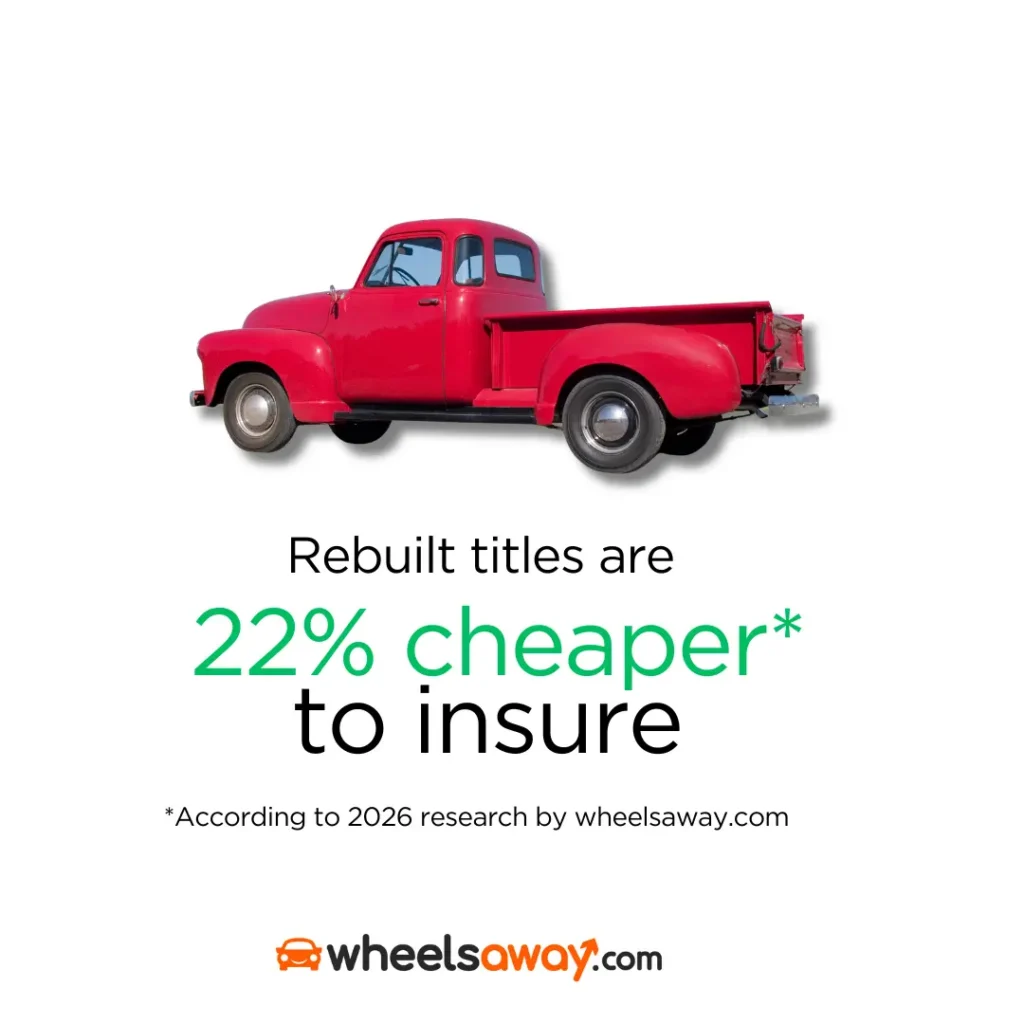
Across the four insurers we quoted, rebuilt-title vehicles cost 18% less on average to insure than clean-title vehicles – a difference that adds up to roughly $4,500 over an estimated 8-year vehicle lifespan.
*Not every insurer followed the trend; some quoted rebuilt vehicles higher. The average across providers still stands. Estimated average lifespan of a rebuilt-title vehicle: 8 years
Risk of insuring a car with a rebuilt title
The benefits of cheaper insurance can be offset by higher costs and risks down the line.
Limited coverage options
Rebuilt titles can be hard to insure. Not all insurers are willing to offer collision or comprehensive insurance, and liability insurance is not enough to protect you in the event of an accident or collision.
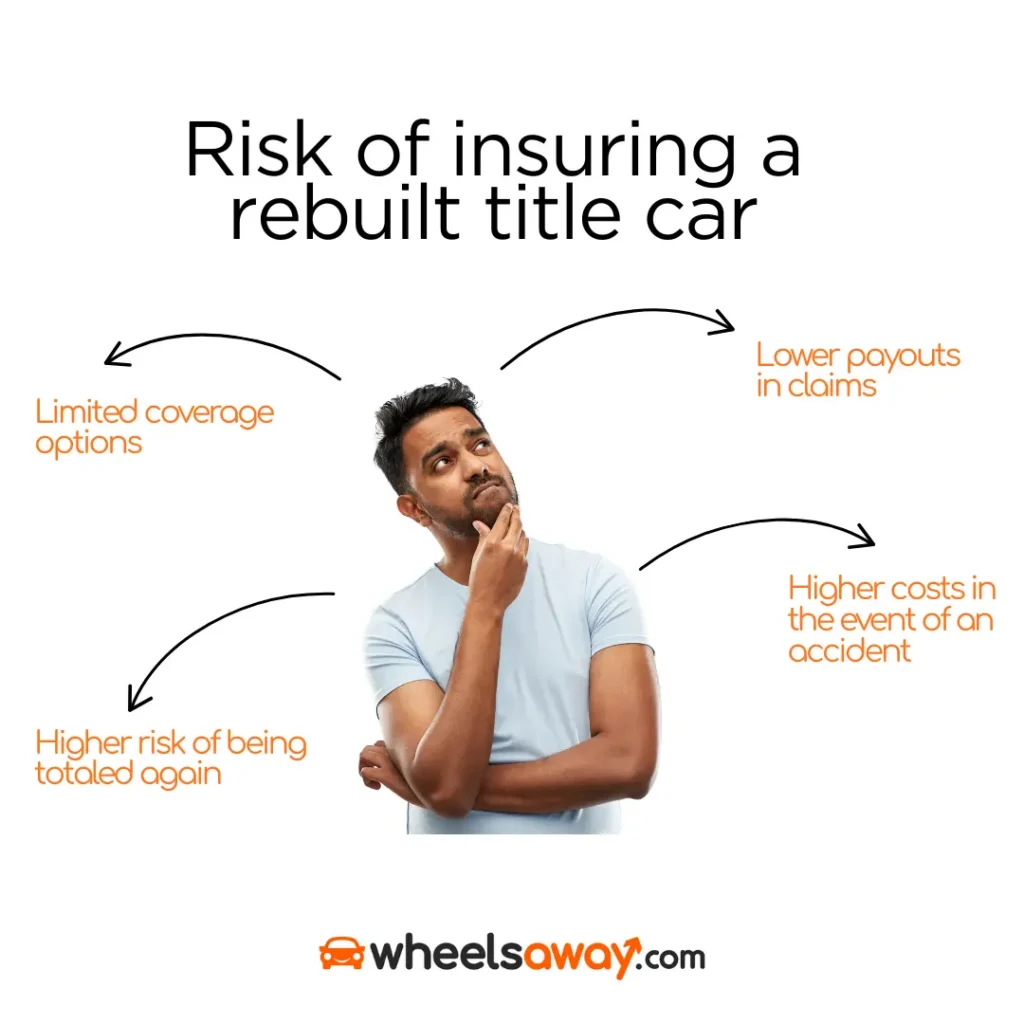
Higher costs in the event of an accident
If you caused an accident without collision coverage, your insurer wouldn’t pay a cent for your car.
With data suggesting the average cost to repair moderate crash damage ranges between $1-$5k, with severe structural repairs reaching as high as $15k, that $5k you saved on insurance becomes meaningless. You may end up needing to salvage or junk your car to avoid the repair costs.
If you’re in a not-at-fault accident without collision coverage, delays can lead to higher upfront costs – even if you’re reimbursed later – making the process stressful.

You’ll also have more to worry about than your finances. As Mike Kruse, Criminal and DUI Lawyer at Kruse Law explains, in the event of an accident, limited coverage could put you in legal hot water – fast.
“Saving several hundred dollars in premiums is no bargain when it appears in the courtroom as a testimony of fiscal irresponsibility.
In the case of DUIs, in particular, such decreased policy limits run out easily in cases of injuries and damage to vehicles, and anything above those limits is the personal issue of the driver. I have observed judges in sentencing consider the financial loss uncompensated when the coverage ran out, and it rarely favors the defendant.“
Lower payouts in claims
Even with full coverage insurance, your payout in the event of an accident or collision would be low. Payouts are based on the Actual Cash Value (ACV) of a vehicle. Rebuilt title cars are worth approximately 20-40% less than clean title cars, though exact valuations vary by insurer, which could make your payout far less than the price you paid for the vehicle in the first place.
Higher risk of being totaled again
There’s a higher risk that a rebuilt vehicle could be totaled again due to its lower market value and the possibility of undetected structural damage that could compromise its integrity in a collision. “Liability insurance keeps you legal, but it doesn’t protect your car”, explains Clifford. “I’ve seen clients buy rebuilt cars, carry liability-only, and then lose the entire vehicle in a second loss with zero payout”. If you want to buy a rebuilt title car and keep it for the long-term, this is important. You could end up losing the vehicle completely – in the same situation, with full coverage, you’d be protected. Can you afford to take this level of risk for a long-term investment? If the answer is no, you should be prepared to pay more for a clean-title vehicle.
Expert support at every step
Get expert advice at every step of your junking journey. From junking without a title to inside tips on how to boost your payout, Wheels Away can help!
Cash for junk cars
Get an instant quote for your vehicle and learn how simple the process is with Wheels Away.
Scrap car prices
Discover what factors influence the price of your scrap car and how to maximize your payout.
Junk cars without a title
Trying to sell a junk car without a title? Learn how our team can help take the paperwork admin off your hands.
Junk car removal
We offer FREE removal for all vehicles! Learn more about the process and book your free pickup today.
Wheelsaway blog
The latest news from our expert team.