
Tree Sap on Cars Is a Bigger Problem Than You Think (These US States Are Most at Risk)
|
|
Contents
Which states are worst affected?
Why is sap such a problem in spring?
How to remove tree sap off a car
Methodology
Spring is finally here, bringing longer days, weekend getaways, and beautiful blooms – but that beauty comes with hidden dangers for your car. Parked up under a sap-producing tree? You might return to a sticky mess that could leave long-lasting damage to your paintwork.
With more Americans searching online for quick fixes, it’s clear many drivers are falling victim to this seasonal nuisance. To pinpoint the worst-hit areas, vehicle specialists at Wheels Away combined U.S. Forest Service data, tree-per-capita stats, and Google search trends to create a Tree Sap Exposure Index, highlighting the states where drivers are most at risk of falling victim to this sticky situation.
Which states are worst affected?
According to Wheels Away’s analysis, Maine topped the list at number one, with 3292 trees per capita, and a sap risk index score of 86. That’s no surprise when you consider that the Pine Tree State is home to an estimated 17.52 million acres of forest land, covering approximately 89% of its land area!
Trees like the beloved maple (sugar, red and silver) are some of the most common species, thriving in the state’s forested, moist and rocky habitat. Red and sugar maples are particularly widespread in residential areas, and frequently host aphids and scale insects, which produce a large amount of honeydew.
That combination results in an unfortunate, sticky mess on your car.
Other culprits include oak trees, linden trees and of course, pine trees, which produce a sticky and hard resin that dries on paintwork fast.
| Rank | State | Sap Risk Index |
| 1 | Maine | 86 |
| 2 | New Hampshire | 70 |
| 3 | Washington | 58 |
| 4 | Oregon | 57 |
| 5 | Alabama | 53 |
| 6 | California | 52 |
| 7 | South Carolina | 51 |
| 8 | Georgia | 51 |
| 9 | Mississippi | 51 |
| 10 | North Carolina | 49 |
New Hampshire follows in second place, with 883 trees per capita and a sap risk index score of 70. It’s estimated that a massive 84% of this state is drenched in woodland, making it one of America’s most heavily forested states. Maple, beech, birch, and pines dominate its landscape.
Following closely behind in third place is Washington, with 722 trees per capita and a sap risk index score of 58. Motorists here will be all-too familiar with the sticky nuisance of its worst-offending native hardwoods, like the black cottonwood and bigleaf maple.
Why is sap such a problem in spring?
While drivers are busy taking in the warmth, colours, and smells of the season on their road trips, they can be quick to forget the risks of sap damage, as automotive expert Luke Oswald reminds us:

“Tree sap is one of those things most drivers don’t think about until they come back to their car and find sticky spots all over the paintwork. Spring is when trees start producing more sap as temperatures rise, so cars parked under trees overnight or during the day are much more likely to end up coated in it.”
Damage from insects like aphids, storms and environmental stress, like drought, heat or poor soil conditions, can all accelerate sap production.
Thanks to the sap’s high sugar content, it hardens quickly – which is bad news for motorists. The longer sap sits on your car, the harder it is to remove. “Once it dries, it can stick firmly to the surface and take a lot more effort to remove, which is why dealing with it early makes a big difference”, explains Luke.
How to remove tree sap off a car
An increasing number of motorists are finding their cars coated in sap residue, and turning to Google for answers.
Google search queries around tree sap removal are set to surge, with Wheels Away’s analysis noting historical seasonal increases in queries across some of the worst-affected states, such as Washington, New Hampshire, and Maine.
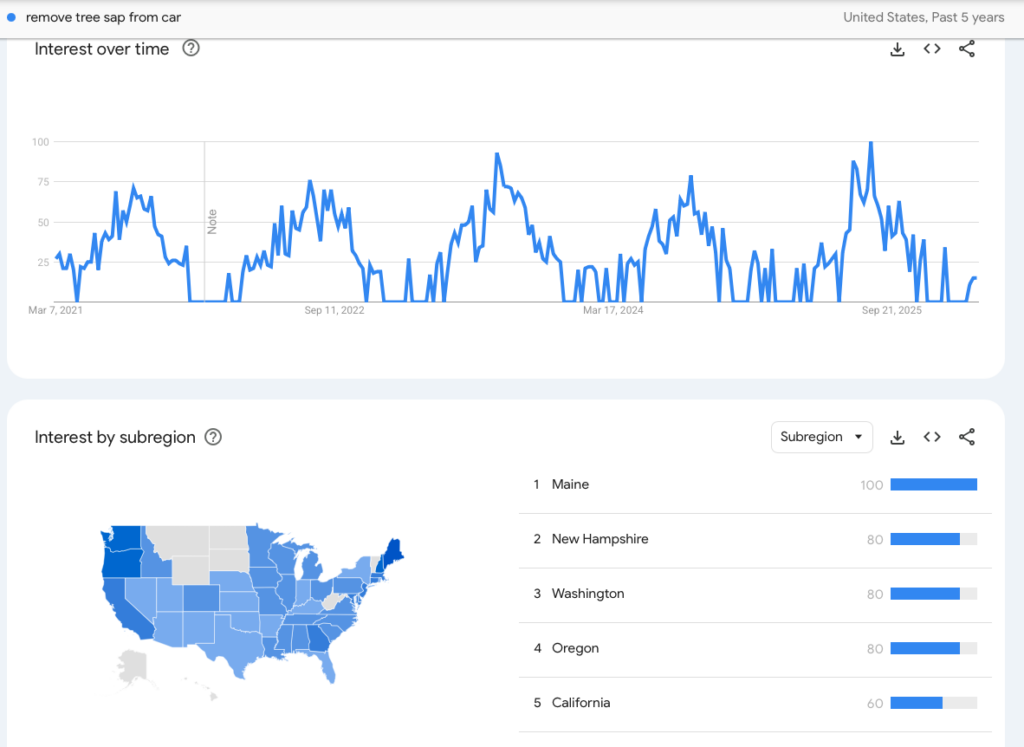
With web and social results offering unverified suggestions of quick fixes with household products and harsh chemicals, drivers risk doing even damage to their paintwork by following reckless advice.
“Unfortunately, there’s no quick-fix and these at-home fixes are likely to cause more damage”, explains Luke.
That’s why we’ve put together a short list of the do’s and don’t’s of sap removal, informed by our in-house vehicle specialists, to ensure drivers care for their cars the right way.
| Do’s | Don’ts |
| Remove sap as soon as possible before it hardens onto paintwork. | Scrape it off with a sharp object – you’ll scratch the paint off. |
| Wash the area using warm water and specialist car shampoo, using a microfibre cloth or wash mitt. | Wash with acetone or petrol – this can damage the paint and protective coating. |
| Use a specialist sap remover if the deposit has hardened, allowing it to soak before gently wiping away. |
Methodology
The 2026 U.S. Tree Sap Exposure Rankings are based on analysis conducted by automotive experts at Wheels Away to identify the states where drivers are most likely to encounter tree sap on their vehicles.
The rankings are based on a Tree Sap Exposure Index, combining three datasets:
- Google search interest for terms including “how to remove tree sap from a car” and “tree sap remover for cars”
- Forest coverage by state, using data from the U.S. Forest Service
- Tree density, measured using trees per capita estimates
To ensure a fair comparison across states:
- Search interest reflects relative Google search popularity by state
- Forest coverage and tree density were used to estimate how likely vehicles are to be parked beneath sap-producing trees
- The three datasets were combined into a single index score used to rank states from highest to lowest tree sap exposure risk
Search interest data covers the period January 2004 to March 2026.